
Joint research through industry-academia-government collaboration utilizing each sector’s advantages
- Solutions
-
Background
It has long been known that mica has the characteristic of selectively adsorbing specific ion species.
A public research institutes and university in Fukuoka Prefecture are studying adsorbents for environmental purification, and have requested the cooperation of Okabe Mica with know-how for mica, and the company joined the collaborative research project. -
Challenges
Basic research was necessary to obtain optimal conditions for a highly efficient mica adsorbent.
-
Solutions
It is known that by replacing potassium ions coordinated in the mica crystal layer with other ions, it becomes a highly efficient adsorbent for specific ion species.
To perform this substitution reaction efficiently with good yield and low cost, the type and shape of mica were optimized to achieve high selectivity as an adsorbent.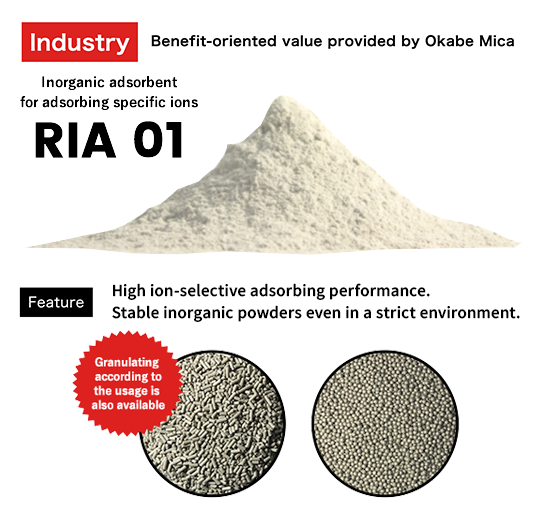
●Prompt procurement of mica materials from Japan and overseas.
●Staff were mainly assigned from those who majored in chemistry.Because they were familiar with chemical reactions, they could smoothly make proposals about production, etc.
●Proposing product forms with consideration for usability from the user’s point of view.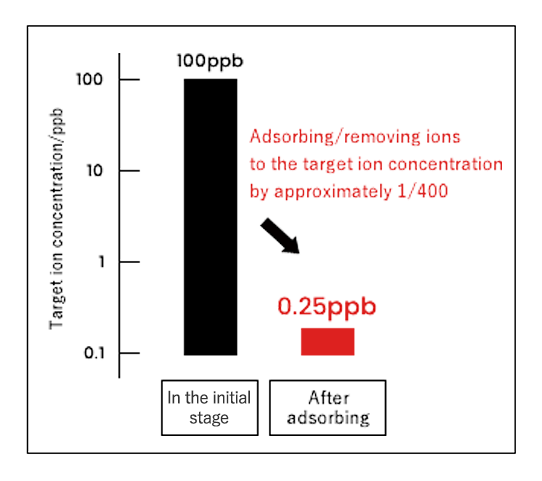
Because there were personnel who could evaluate manufactured items, they knew which analysis laboratory and equipment should be used and could create rationales for developed products, even if there was no evaluation equipment in the company.
Test description
As a representative characteristic, we evaluated the adsorption and removal characteristics of specific ions when RIA-01 was added to a solution containing specific ion species.
Test condition
After adding 0.1 g of RIA-01 into 10 ml of specific ion species solution with 100 ppb, we left it as it is for a week.
Analysis method
Using ICP-MS, we measured concentration of specific ion species.
Conclusion
Okabe Mica has the ability to procure mica.
Additionally, we have the ability to conduct experiments by staff specializing in chemistry. In this project, personnel with analytic chemistry experiences performed qualitative confirmation and identification of prototype substituted mica to analyze how ion species were adsorbed.
We also looked for the best method through a wide range of industry-academia-government networks and promptly studied synthetic methods and granulation.